

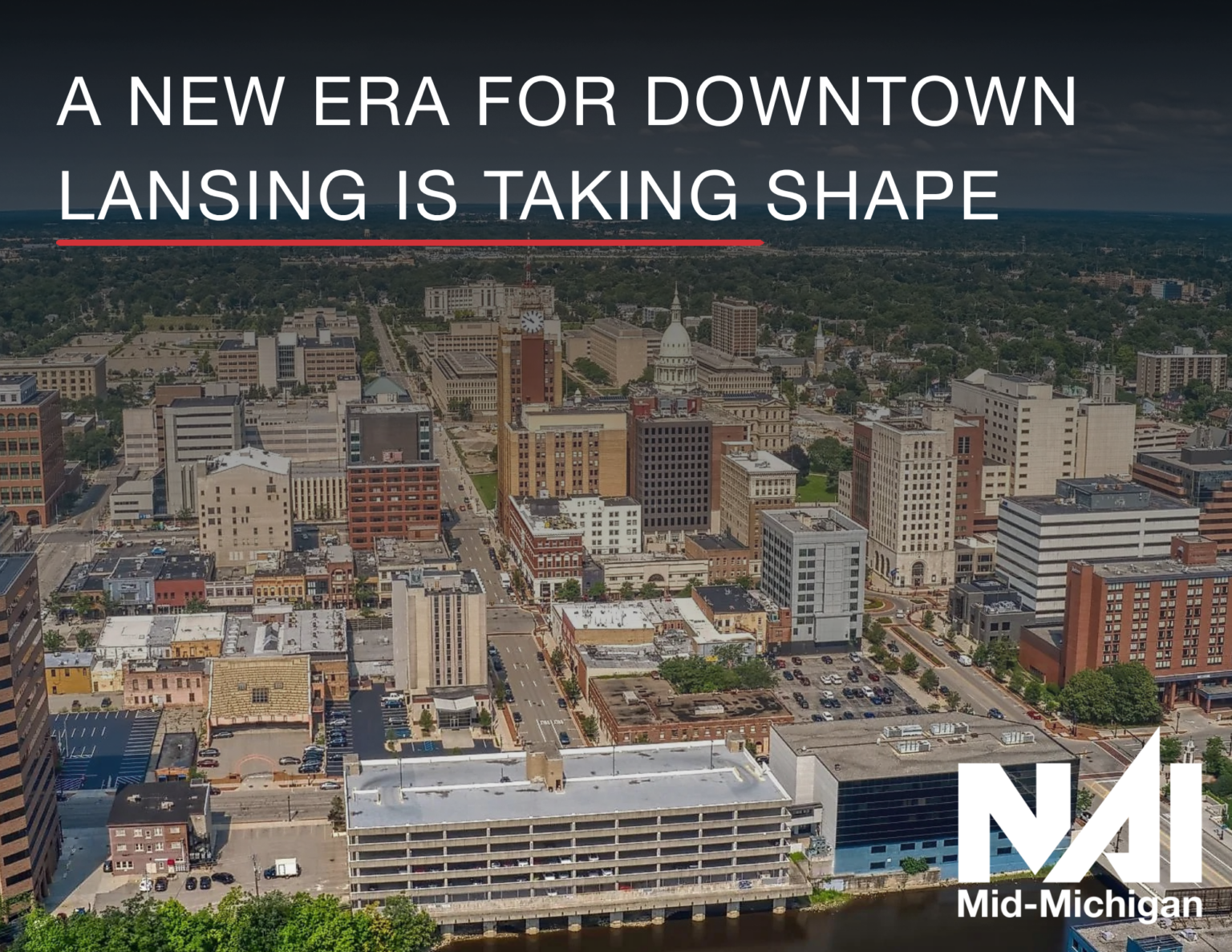
For decades, downtown Lansing shared the same problem as most state capitals: a core that buzzed at 9 a.m. and emptied out by 5 p.m. Plenty of offices, plenty of daytime workers, and not nearly enough people who actually lived there.
That’s changing. Close to 1,000 new residential units are moving through downtown Lansing’s development pipeline — and unlike a lot of “coming soon” talk, the headline projects have funding, timelines, and partners locked in. Here’s why this wave matters for the downtown market, and what commercial real estate professionals should take from it.
The Market These Projects Are Landing In
The most important thing to understand about downtown Lansing right now is that it’s supply-starved, not saturated.
The Lansing–Ann Arbor metro (as RentCafe groups it) has ranked among the nation’s most competitive rental markets. In its peak-season 2025 analysis, RentCafe reported roughly eight renters competing for each available apartment, units filling in about 34 days, and an occupancy rate near 94.4% — above the national average of about 93.4%. More than two-thirds of renters renewed their leases, which keeps even fewer units coming back to market.
Rents have climbed at a healthy, above-inflation pace, if not a dramatic one: RentCafe/Yardi Matrix data put average Lansing rent around $1,220 in late 2025, up roughly 4.7% year-over-year, with the tighter city submarket up closer to 5.6%. The through-line is simple — demand has been here for years, and the housing supply hasn’t kept up. That’s the gap this pipeline is built to fill.
What’s Coming
New Vision Lansing — the centerpiece
The signature project is New Vision Lansing, a five-building, roughly $315 million development from Lansing-based Gentilozzi Real Estate in partnership with Bloomfield Hills-based JFK Investment. Together the buildings will add close to 600 residential units across downtown and Old Town, with construction phasing through 2026 and 2027.
Its crown jewel is the Tower on Grand at 215 S. Grand Avenue — a 28-story, 287-unit high-rise that broke ground in spring 2025 and is set to become the tallest building in Lansing, surpassing the Boji Tower, which had held that title since 1931. Leasing is expected to begin around 2027–2028. The project has drawn significant public support, including a $40 million state grant and additional tax incentives, reflecting how central it is to the city’s downtown strategy.Office-to-residential conversions — the structural shift
Two conversions are turning underused office space into homes:
- 100 S. Washington Square — a 10-story, century-old office building (once home to the Michigan Court of Appeals) being converted into roughly 60 apartments at workforce rents, with ground-floor retail, targeted for completion in fall 2026. It’s part of New Vision Lansing and sits a block from the Capitol — a deliberate proof-of-concept for downtown office conversion.
- The Prudden Building — upper floors of the historic structure being reborn as apartments, with ground-floor retail restored.
Each conversion does double duty: it takes empty office space off the market and puts residents on the street — a win for a downtown that needs both.
Workforce and affordable housing — the foundation
Beyond market-rate development, several income-restricted projects round out the mix. Two Lansing Housing Commission developments — Riverview 220 (market-rate plus subsidized units on South Kalamazoo Street) and Grand Vista Place (subsidized units off Grand Avenue) — are among those advancing, alongside additional workforce and affordable proposals from established local developers. A diversified renter base is a resilient one, and this pipeline spans market-rate high-rise, workforce, and affordable housing aimed at state employees, teachers, young professionals, and families.
What It Does to the Market
Absorption risk is low. These units are phasing in over two to three years, into a market already running tight on inventory. This reads as catch-up, not oversupply.
The conversions do double work. Turning underused office space into apartments trims office vacancy while adding the residents who keep restaurants, shops, and sidewalks alive after dark — the “critical mass” local economic development leaders have repeatedly said downtown needs.
The mix is healthy. Spanning market-rate, workforce, and affordable housing, the pipeline draws from a broad renter base rather than betting on a single segment.
Public-private partnership is doing the heavy lifting. State grants, brownfield and tax incentives, and coordinated city support are what moved these projects from proposal to groundbreaking — a model worth watching as other mid-sized downtowns pursue similar revitalization.
Headwinds Worth Watching
A grounded read also accounts for the risks:
- Construction and financing costs remain elevated nationally, which can stretch timelines on large builds like Tower on Grand.
- Incentive dependence: several projects rely on state appropriations and tax incentives, and public funding debates have delayed comparable Lansing developments before.
- The 5 p.m. question: the entire thesis rests on convincing enough people to live downtown — not just work there. Early absorption on the first completed buildings will be the real test.
The Bottom Line
Downtown Lansing is adding housing into genuine scarcity, led by smart office conversions and strong public-private partnerships. The demand is proven, and the anchor projects are real and funded. After years of waiting for downtown to “happen,” 2026 and 2027 are shaping up to be when it actually does — changing both the skyline and the address a new generation of Lansing residents will call home.
Frequently Asked Questions
What is the New Vision Lansing project? A roughly $315 million, five-building development from Gentilozzi Real Estate and JFK Investment, adding close to 600 residential units across downtown Lansing and Old Town, anchored by the 28-story Tower on Grand.
How tall is the Tower on Grand, and when will it open? The Tower on Grand is a 28-story, 287-unit high-rise at 215 S. Grand Avenue that will become Lansing’s tallest building. It broke ground in 2025, with leasing expected around 2027–2028.
How many new apartments are coming to downtown Lansing? Close to 1,000 residential units are in the pipeline across downtown and adjacent neighborhoods, spanning market-rate, workforce, and affordable housing.
Is downtown Lansing a good market for real estate investment? Fundamentals are tight: metro occupancy above the national average, one of the country’s more competitive rental markets, high lease-renewal rates, and limited new supply relative to demand. As always, returns depend on basis, financing, and execution.
Following the Mid-Michigan market?
NAI Mid-Michigan tracks commercial real estate and development activity across Lansing, East Lansing, and the broader Mid-Michigan region. Contact our team for investment sales, tenant representation, and market intelligence.
Sources
- City Pulse — “Work begins on downtown Lansing’s grandest vision” (Tower on Grand groundbreaking): https://www.lansingcitypulse.com/stories/work-begins-on-downtown-lansings-grandest-vision,133079
- City Pulse — “20 developments and projects we’ll be watching in 2026”: https://www.lansingcitypulse.com/stories/here-are-20-developments-and-projects-well-be-watching-in-2026,174506
- Lansing Economic Development Corporation — New Vision Lansing project page: https://lansingedc.com/our-work/active-projects/new-vision-lansing
- The Detroit News — “Developers break ground on 28-story building”: https://www.detroitnews.com/story/business/2025/04/07/developers-break-ground-on-28-story-apartment-building-in-lansing/82977003007/
- RentCafe — Lansing–Ann Arbor rental competitiveness (peak season 2025), via Michigan Business Network: https://michiganbusinessnetwork.com/rentcafe-lansing-rentals-snapped-up-fast-in-2025-8-renters-compete-for-an-apartment-this-peak-season/
- RentCafe — Average Rent in Lansing, MI (market trends): https://www.rentcafe.com/average-rent-market-trends/us/mi/lansing/
