

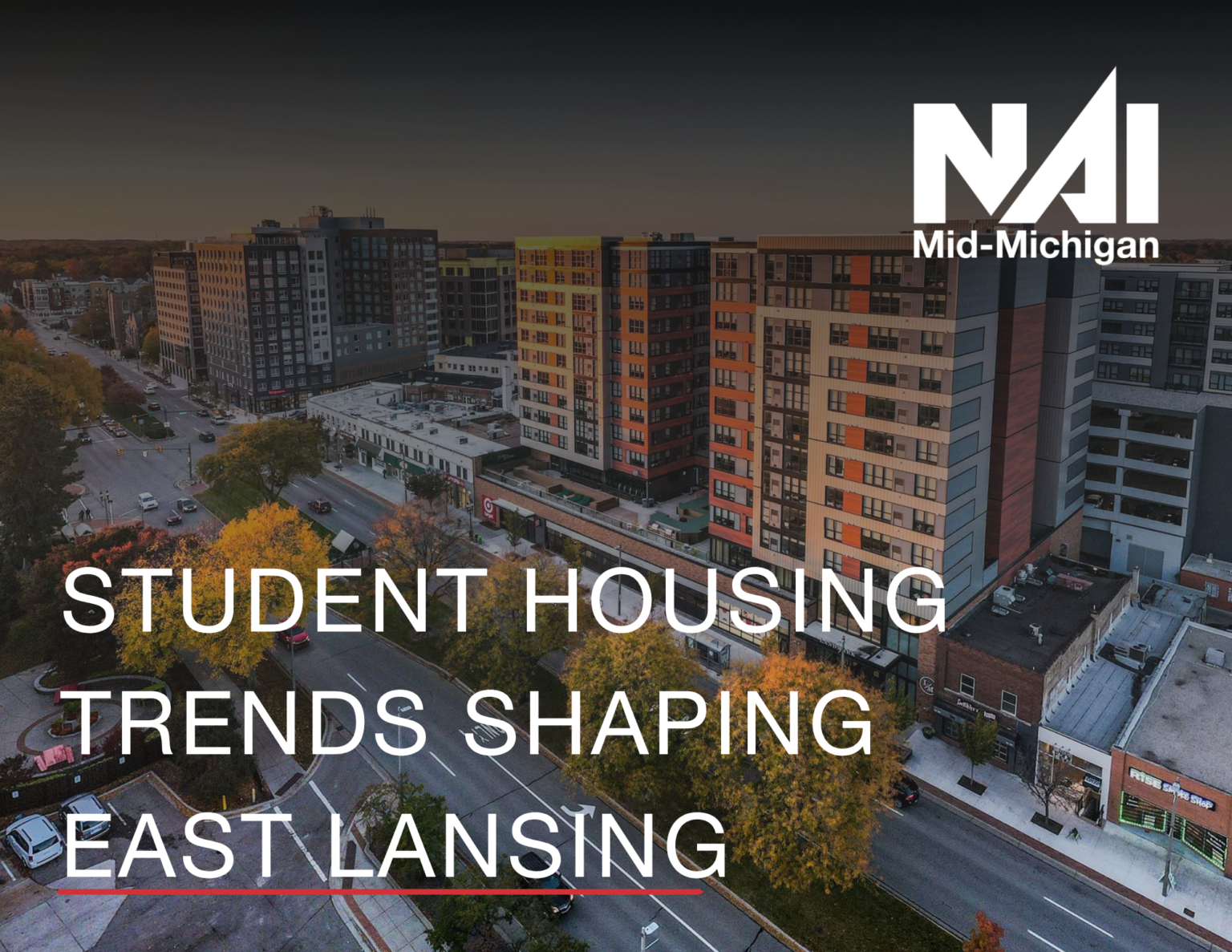
As Michigan State University remains one of the largest universities in the nation, East Lansing student housing continues to be one of the most influential drivers of commercial real estate activity in the region. In June 2026, a global investment manager paid to enter the market for the first time, two high-rise towers are working through city approvals, and national occupancy is sitting near a multi-year high. For commercial real estate professionals across Mid-Michigan, the signals are hard to ignore.
Here’s a grounded look at what’s actually happening in the market right now — and why it matters for investors, developers, and the businesses that serve the campus community.
A Market Transformed Over the Past Decade
What was once dominated by traditional rental homes and small apartment buildings has become a competitive landscape of amenity-heavy, mixed-use developments built for the expectations of today’s students. The arrival of large buildings like The Hub, The Abbot, The Landmark, and the Graduate hotel reshaped the downtown skyline in the late 2010s and early 2020s.
That shift is the backdrop for everything happening now. Purpose-built student housing (PBSA) near major universities has matured from a niche “mom-and-pop” business into an institutional asset class, and East Lansing is firmly on the map.
Institutional Capital Signals Confidence: LaSalle’s Red Cedar Flats Acquisition
The clearest recent signal came on June 11, 2026, when LaSalle Investment Management — a subsidiary of JLL that managed roughly $86.9 billion in real estate assets as of Q4 2025 — announced its acquisition of Red Cedar Flats, a 190-unit, 436-bed purpose-built community within walking distance of MSU. LaSalle bought the property on behalf of its LaSalle Value Partners IX fund, alongside joint-venture partners King Bridge Partners and Clear Rock Capital, with student housing specialist University Partners handling management.
Several details make this transaction noteworthy for the local market:
- It was the fund’s first-ever investment in the student housing sector, signaling a deliberate move into the asset class — with East Lansing chosen as the entry point.
- LaSalle reported acquiring the asset below replacement cost with in-place cash flow, the kind of value-add profile that tends to attract additional institutional buyers to a market.
- Leadership tied the deal directly to MSU’s enrollment strength and constrained local housing supply, describing campus-adjacent student housing as an attractive residential subsector.
When capital of this scale targets East Lansing, it tends to validate the market for other investors watching from the sidelines.
The Numbers Behind the Demand
Strong fundamentals support that confidence – both nationally and at MSU specifically.
National occupancy is near a multi-year high. According to Yardi Matrix data reported by Multi-Housing News, national student housing occupancy across the Yardi 200 universities reached an estimated 95.1% for the 2025–2026 academic year, up from 93.6% a year earlier and one of the strongest readings in recent memory — even as new beds continued to deliver. (This is a meaningful update from the “above 91%” figure that circulated in earlier coverage.)
Rent growth has cooled, but stayed positive. The same data showed national rent growth slowing to roughly 0.8% in 2025 — the most modest pace since Yardi began tracking the sector in 2017 — with average rents near $905 per bed. Slower growth reflects more competition and strategic pricing, not weakening demand.
Supply is tightening. Roughly 27,000 new beds delivered nationally in 2025, down from nearly 35,000 in 2024, as elevated construction, financing, and material costs thinned the development pipeline. Constrained new supply is generally supportive of occupancy and rents in established markets.
MSU demand remains exceptional. Michigan State enrolled 51,838 students in fall 2025, its second-largest class ever (just behind the prior year’s record of 52,089), per MSU’s enrollment release. Undergraduate enrollment of 41,415 was the largest in school history. With tens of thousands of students and limited on-campus capacity, the structural demand for off-campus housing near campus is deep and durable.
A Development Pipeline That’s Reshaping Downtown
The most active part of the story is local. Two major high-rise projects are working through East Lansing’s approval process, and together they would add well over 1,000 beds downtown:
- 530 Albert Avenue (Bailey Street lot): Tareen Development Partners has proposed a 13-story, roughly 236-unit / 505-bed mixed-use building with ground-floor retail and structured parking. The city’s Planning Commission recommended approval in a 6–2 vote in early 2026, and the project advanced through public hearings that spring.
- “The Howard” at 401 E. Grand River Avenue (Student Book Store site): A 15-story project from the Ballein family and Harbor Bay Ventures, featuring a mass-timber design and several hundred beds. Backers have described it as a roughly $127 million investment supporting nearly 1,000 construction jobs.
Additional concepts, including a proposed second phase of The Hub, point to continued developer interest near campus. As reported by East Lansing Info, these proposals remain subject to a lengthy public approval process — but their scale underscores how developers read the demand picture.
What This Means for Commercial Real Estate
For CRE professionals, student housing development serves as a leading indicator of future economic activity. As more residents move into downtown East Lansing, the ripple effects reach well beyond multifamily:
- Retail and restaurant leasing opportunities increase as foot traffic and the year-round residential base grow.
- Mixed-use development becomes more attractive, with ground-floor commercial space built into nearly every new tower.
- Property values may benefit from sustained demand and institutional pricing benchmarks set by deals like Red Cedar Flats.
- Investor interest near campus and downtown continues, supported by occupancy and rent fundamentals that have outperformed conventional multifamily.
In short, student housing sustains the residential population that local retailers, restaurants, and service businesses depend on — making it a foundation for broader commercial growth.
Headwinds Worth Watching
A credible market read also accounts for the friction. Several factors could shape how this plays out:
- Affordability and policy: East Lansing requires that 25% of units in new downtown developments serve low-to-moderate-income or other “diverse” housing needs. Debates over a potential fee-in-lieu program could influence which projects pencil out.
- Parking and neighborhood character: Downtown zoning restricts parking in new development, and residents have raised concerns about density and traffic — recurring themes at recent public hearings.
- Demographics and enrollment: National forecasts point to a declining number of U.S. high school graduates beginning in 2026, and tighter international-student policy is expected to pressure some markets. Large, in-demand institutions like MSU are better insulated, but the trend is worth tracking.
- Construction costs: Elevated material and financing costs continue to challenge new development nationally.
Looking Ahead
The future of East Lansing’s commercial real estate market remains closely tied to Michigan State University and the continued evolution of student housing. Discussions around density, parking, affordability, and neighborhood character will continue — but the development pipeline and recent institutional investment both signal that East Lansing remains an attractive destination for capital.
As new projects move through approvals, student housing will likely remain one of the most important forces shaping the city’s growth — creating opportunities not only for developers and investors, but for the businesses that serve the university community.
Frequently Asked Questions
Is East Lansing a good market for student housing investment? Fundamentals are strong: near-record MSU enrollment, constrained on-campus supply, national occupancy around 95%, and recent institutional acquisition activity all point to durable demand. As with any investment, returns depend on basis, financing, and execution.
What was the LaSalle Red Cedar Flats deal? In June 2026, LaSalle Investment Management acquired Red Cedar Flats, a 436-bed purpose-built student housing community near MSU, on behalf of its LaSalle Value Partners IX fund – its first investment in the student housing sector.
How many students attend Michigan State University? MSU enrolled 51,838 students in fall 2025, including a record 41,415 undergraduates, making it one of the largest universities in the country.
What new student housing is being built in downtown East Lansing? Two high-rise proposals – a 13-story building at 530 Albert Avenue and the 15-story “The Howard” on Grand River Avenue – are working through the city’s approval process and would together add more than 1,000 beds downtown.
Want a deeper read on the Mid-Michigan market?
NAI Mid-Michigan tracks commercial real estate activity across East Lansing, Lansing, and the broader Mid-Michigan region. Contact our team for tenant representation, investment sales, and market intelligence near Michigan State University.
Sources:
LaSalle Investment Management — “LaSalle acquires purpose-built student housing near Michigan State University” (June 11, 2026): https://www.lasalle.com/news/lasalle-acquires-student-housing-near-michigan-state-university/ PR Newswire / Connect CRE coverage of the Red Cedar Flats acquisition: https://www.connectcre.com/stories/lasalle-acquires-student-housing-complex-near-michigan-state-university/ Multi-Housing News — National Student Housing Report (Yardi Matrix data), October 2025: https://www.multihousingnews.com/national-student-housing-report-october-2025/ MSUToday — “Strong student demand pushes MSU to near-record enrollment” (Sept. 2025): https://msutoday.msu.edu/news/2025/09/fall-2025-enrollment East Lansing Info — coverage of the 530 Albert Avenue and “The Howard” development proposals: https://eastlansinginfo.news/two-massive-apartment-complexes-are-proposed-for-downtown-east-lansing-where-would-everyone-park/ City of East Lansing — Projects: https://www.cityofeastlansing.com/539/Projects Cushman & Wakefield — Student Housing Trends & Valuation Indices: https://www.cushmanwakefield.com/en/united-states/insights/student-housing-trends-and-valuation-indices
